
Basics of Knitting for Beginners
Before You Start
Learn more about reading a pattern. Explore
Reading A Yarn Label
-
Want to learn about a yarn? Look at the skein band or ball band on it! Keep reading this blog to learn how to read a skein band.
Follow along as we read a skein band! We're using Super Saver in our example. To start, position your yarn so the Red Heart logo is facing you.
Outside of Band

The big red heart on the skein band tells you this is Red Heart Yarn! Underneath the Red Heart name the logo tells you that this particular skein is our Super Saver yarn.
Above the logo a line says that the yarn is worsted weight, or a 4 weight in the Craft Yarn Council yarn classification system that we use.
Underneath the heart you can see the small American flag in the left hand corner indicating that the yarn is Made in the USA. On the right-hand corner is the fact that Super Saver does not have dye lots in solid colors. You can see this written in English, French, and Spanish. To meet regulations the copy on the ball band must be in multiple languages.
Turn the skein slightly away from you so you can see the picture of the free pattern. Your picture may be different than the one in our example. One type of yarn may have the same pattern on all of the skein bands or it may have different patterns on different skein bands. Which pattern is on any particular skein of yarn is just due to chance.

At the top of the skein band in this shot you can see a red line where it gives the net weight and the yardage for this skein. In the US yarn is sold by weight, so this skein is 7 ounces or 198 grams. The yardage given is an estimate and is the least amount of yarn you will encounter in the skein; the actual amount may be more. Since yarn is sold by weight and not by yardage no two skeins of yarn will have the exact same yardage.
The picture shows the free pattern available on the inside of the ball band. This particular free pattern is for the Double-Sole Slippers; the picture has the pattern number superimposed on top of it. The white box to the left of the pattern picture has a crochet hook, so you can tell this is a crochet pattern. Other skein bands may have an image of crossed knitting needles to tell you that the free pattern is knit. The numbers printed in the white box indicate the size of the crochet hook (or knitting needles, for other patterns) used in the free pattern. This particular free pattern uses a 5.5mm [US I-9] crochet hook. Below the white box the number of skeins needed for the picture and the color shown in the picture are listed. This pattern uses 1 skein of 319 Cherry Red.
Social media logos are listed below the pattern information. If you go to YouTube, Facebook, or Twitter, you will be able to find Red Heart Yarns accounts.
Below the pattern picture is our website, then you get to the technical information: the manufacturing details of the yarn, our address, manufacturing and recycling information for the paper, and the importing information for our business in Mexico.

If you continue turning the skein you'll see a white sticker holding the ends of the skein band together. The sticker gives the name of the yarn color above the article number and the color number. For this skein the color is Cherry Red, the article number is E300, and the color is 0319. The other numbers show when it was manufactured. Super Saver does not have any dye lots in solid colors, but yarns that do have dye lots have the dye lot information also printed on the skein band. The bar code allows the skein to be identified and for you to buy it at the store.

If you turn it away from you again, underneath the "No Dye Lot" notice are the yarn information, gauge, and washing instructions.
Left to right, the boxes are for:- This yarn has a weight of 4 in the Craft Yarn Council classification system.
- The gauge of this yarn with 5mm/US 8 knitting needles is 17 stitches and 23 rows in 4"x4" (10 cm x 10 cm).
- The gauge of this yarn with a 5.5mm/US I-9 crochet hook is 12 single crochets and 15 rows in 4"x4" (10 cm x 10 cm).
- This yarn can be machine washed.
- This yarn can be tumble dried.
- You should not use an iron on this yarn.
The general laundry instructions and the fiber content of the yarn (100% acrylic) are listed next.
The next set of pictures shows you that this yarn is a skein, and that you can pull it from the center. For more details on this, please see our blog on the difference between balls and skeins of yarn. Now you're back at the beginning!
Inside of Band
To look at the inside of the band, slide the band off of the skein. At the white sticker carefully pull so the band opens flat without ripping. The inside of the band has a written pattern for the image on the outside of the band. The pattern is given in French and English. You can also find the pattern on our website by searching the number that is shown on the picture.
What other questions do you have? Let us know in the comments!
Choosing the Right Yarn
-
Everyone talks about yarn weight — what does it mean? When we refer to yarn weight, we're not talking about the weight of the ball or skein. Instead, we're talking about how thick or thin yarn is.
Yarnspirations follows the Craft Yarn Council (CYC) Standard Yarn Weight System. In this system, yarn is divided into weights 0 to 7. The thinner the yarn, the smaller the number. For example, Aunt Lydia's Classic Crochet Thread Size 10 would count as a size 0 (Lace). Red Heart Super Saver, Caron One Pound and Bernat Super Value are all size 4 (Medium), and Bernat Plush Big is a size 7 (Jumbo).
Just because yarn is the same weight doesn't mean it is identical: Red Heart Super Saver, Caron One Pound, and Red Heart Soft all have a weight of 4, but they are slightly different sizes and have slightly different gauges. Each weight of yarn has a range of similar gauges.
Each of our yarns has the symbol for their weight on the ball band. You can search our yarn by weight on the website: click on "Yarn" in the top navigation bar, and then select the weight you need under the "Weight" column.
If you want to substitute yarn in a pattern, weight is one component. It is easiest to substitute between yarns of the same weight, such as using Red Heart Super Saver or Caron One Pound in a pattern. You will still need to check the pattern gauge, however, to make sure that the project you are making will turn out the correct size.
Lace Weight

Lace weight yarn also known as fingering yarn and 10 count crochet thread is very thin yarn used for lacy projects such as doilies and lace shawls.
Super Fine

Super fine yarn may also work for lace projects since it is great for creating delicate garments. Super fine yarn is commonly used to make socks, shawls and baby items. Shop super fine yarns.
Fine

Fine yarn often referred to as Sport Weight yarn is also great for creating lightweight and delicate projects. It works well for making socks, heirloom garments and lightweight blanket.Shop sport fine yarns.
Light

Light yarn is slightly thicker than a #2 Fine yarn, it is considered a lighter worsted weight yarn that’s great for making heavier, fine garments and baby items. Shop light (DK) yarns.
Medium

Medium weight yarns are often referred to as Aran or Worsted Weight yarn. Worsted weight yarn is the most frequently used yarn since it is easy to work with. It’s a great yarn for beginners and for those looking to make a variety of projects. Shop Medium weight or worsted weight yarns.
Bulky

Bulky yarn or chunky yarn is almost twice as thick as worsted weight yarn and is great for making scarves, hats, sweaters, and blankets. Due to its thickness this yarn works up quickly when using large hooks or needles. Looking to make a project with a bulky yarn? Shop bulky weight yarns.
Super Bulky

Super Bulky yarn or Roving yarn is thicker and works up quick! This kind of yarn is great for making warm and cozy sweaters, hats, and cowls. Shop super bulky yarns.
Jumbo

The thickest of yarns classified in the Yarn Weight Standards by the Craft Yarn Council. This yarn category was created to classify the trending super thick yarns which started to appear in the yarn world. These jumbo yarns are great for quickly making sturdy and large projects. Start stitching with Shop jumbo weight yarns!
Every pattern either dictates the yarn you need to use to make the project or the yarn weight. This means that you have the option of making a project in the yarn you want by simply switching to a different yarn with the same weight originally called in the pattern. An important thing to note if you choose to switch out one yarn for another when working on a project is to make sure you create a gauge swatch. While most yarns within a yarn weight category are interchangeable not all yarns are identical that’s why it’s helpful to create a gauge swatch, so you can get a sense of the tension you’ll need to maintain in order to achieve the right amount of stitches per inch.
Everyone talks about yarn weight — what does it mean? When we refer to yarn weight, we're not talking about the weight of the ball or skein. Instead, we're talking about how thick or thin yarn is.
Yarnspirations follows the Craft Yarn Council (CYC) Standard Yarn Weight System. In this system, yarn is divided into weights 0 to 7. The thinner the yarn, the smaller the number. For example, Aunt Lydia's Classic Crochet Thread Size 10 would count as a size 0 (Lace). Red Heart Super Saver, Caron One Pound and Bernat Super Value are all size 4 (Medium), and Red Heart Grande and Bernat Mega Bulky is a size 7 (Jumbo).
Just because yarn is the same weight doesn't mean it is identical: Red Heart Super Saver, Caron One Pound, and Red Heart Soft all have a weight of 4, but they are slightly different sizes and have slightly different gauges. Each weight of yarn has a range of similar gauges.
Each of our yarns has the symbol for their weight on the ball band. You can search our yarn by weight on the website: click on "Yarn" in the top navigation bar, and then select the weight you need under the "Weight" column.
If you want to substitute yarn in a pattern, weight is one component. It is easiest to substitute between yarns of the same weight, such as using Red Heart Super Saver or Caron One Pound in a pattern. You will still need to check the pattern gauge, however, to make sure that the project you are making will turn out the correct size.
Types of Knitting Needles
When starting to knit, the act of knitting and using knitting needles feels quite new and at this stage you won’t have developed a strong opinion yet on which type of knitting needles you prefer to work with. With all the choices available we understand that it can be overwhelming to figure out which knitting needles to choose from, so we’ve created a helpful guide. Below you’ll find all the information you need to pick the knitting needles you think will work best for you.

Knitting Needle Materials
Wooden Knitting Needles
Knitting needles made from wood are smooth and have just the right amount of texture to them so the yarn does not slip off the needles as easily. Allowing you to develop an even knitting speed and forming your stitches in a precise manner. A common type of knitting needle used is bamboo, it has similar qualities to wooden knitting needles but at a lower price point. Making it a great choice for beginners over wooden knitting needles like birch. They are durable and lightweight, a favorite among many knitters.
Find wooden knitting needles here.
Metal Knitting Needles
Knitting needles made of metal are commonly made of aluminum while some are nickel plated or made of steel. These knitting needles provide the smoothest surface for knitters, increasing the speed of stitching, which is why metal knitting needles are more suitable for more advanced knitters who are comfortable with their tension. Metal knitting needles also create that classic ‘click’ sound while knitting!
Find metal knitting needles here.
Plastic Knitting Needles
Plastic knitting needles are the least expensive option for knitting needles. They’re a great first set of knitting needles for someone who is interested in trying out knitting for the first time. They are also great for beginners as they are the most lightweight and have a smoothness comparable to wooden knitting needles.
Find plastic knitting needles here.

Knitting Needle Styles
Straight Knitting Needles
Straight knitting needles are the more traditional style of knitting needles. These knitting needles come as a pair, are straight and come in lengths of 7’ and up. They are still used today however;many knitters reserve these knitting needles for smaller projects where you won’t find much bulk sitting onthe needles as you work. They are great for working on scarves, baby blankets and projects worked up in separate pieces like mitered squares.
Find plastic knitting needles here.
Circular Knitting Needles
Circular knitting needles are made of two short pointed ends connected by varying lengths of cord that is usually made of plastic. For some, these knitting needles are the most comfortable to work with as they provide a more even distribution of your stitches. For this reason, they are an excellent choice for those working on larger projects. They are also ideal for working in the round on larger circumferences. However, circular knitting needles are also great for knitting smaller projects making them a versatile style of knitting needles to own. Circular needles can also be used for projects such as afghan that require more sts than what a straight needle will hold.
Find plastic knitting needles here.
Double-Pointed Knitting Needles
Double-pointed knitting needles are shorter needles with two points at the end. These knitting needles referred as DPN’s and are designed for knitting in the round. This means knitting without a seam, which includes some hats, baby hats, socks and some garment sleeves. Double-pointed knitting needles are also great for making i-cords and can be substituted for a cable needle in a pinch!
Find plastic knitting needles here.
Interchangeable Knitting Needles
This style of knitting needles are circular knitting needles with an interchangeable cord. An interchangeable knitting needle set is great for a dedicated knitter since usually these sets come with knitting needles and cords in plenty of sizes, so you can change the length of the cord on your circular knitting needles depending on what your project calls for.
Find plastic knitting needles here.
Knitting Needles Sizes
Your knitting needle size is dependant on what yarn you are using. The thicker the yarn you’re using the bigger the knitting needles you will need. This is so that you can obtain proper gauge. Gauge is the amount of stitches per inch you knit with a specific yarn. You can easily find out what size knitting needles and gauge you will need to achieve with a specific yarn by looking at the product details on a yarn page or by simply looking on the label of a skein of yarn. The knitting symbols below are what you are looking for:

Different ways of Knitting
While there are many different types of knitting needles there are two different styles of knitting; English knitting and continental knitting. For all knitters, the following way to hold your knitting needles is the same whether you knit English or continental.


You hold one needle in each hand with your fingers lightly curled over the top of the knitting needles and your arms slightly bent.
English Knitting
English Knitting is when you use your working hand to also wrap your yarn around your working needle.
Continental Knitting
Continental Knitting is when you use your other hand to wrap the yarn around your working needle, meaning you do not let go of your work while knitting.
Getting Started
Prepare your stitching for success. Explore
Choose Your Knitting Style
How to hold yarn and needles
-
The right needle is held as if holding a knife. The left needle is held lightly in the same position, with the needle tips pointing toward each other.
There are various methods of winding the yarn around the fingers to control the tension and produce even stitches. Use whichever method feels comfortable to you and allows you to keep an even tension on the yarn.
How to Hold the Yarn and Needles English Style
Holding the yarn in your right hand is called English style, or "throwing". Many beginner knitters find this way the easiest.
How to Hold the Yarn and Needles Continental Style
Holding the yarn in your left hand is called continental style, or "picking". This method is faster, and many beginner knitters who already know how to crochet and are used to holding the yarn in their left hands find this method easiest.
The relationship of the yarn and the needles to each other, as you work a stitch, is the same whether you are knitting English style or continental style.
Below is one method of holding the yarn and needles to knit English style. This method works well once you are comfortable making stitches.
Holding the Yarn and Needles English Style
Holding the yarn in your right hand, pass it between the third finger and the pinky. Wind the yarn over the third finger, under the second finger, and over the index finger. Winding the yarn around your fingers creates the tension that is necessary for producing even knitting.

Using a circular needle
Slip Knot
A slip knot is the starting point for just about everything you'll do in knitting. It is also the basis for all casting on methods.
Step 1
Make a circle with yarn or thread.

Step 2
Pull a loop through the circle.

Step 3
Insert the needle into the loop.

Step 4
Pull the loop gently and evenly to tighten and slide the knot up to the needle.

Cast On
Broken down in very simple terms, knitting is just a matter of transferring loops from one needle to another. To get started, you'll need to put loops on one needle, and that process of creating loops is called casting on.
There are several methods of casting on. Each has a unique purpose and produces a different edge. Try different methods to find the one most comfortable and suitable for your project. Two common cast-on methods are the long-tail cast on and the backwards loop cast on.
Unless otherwise noted, the initial slip knot you use to start casting on counts as a stitch in the pattern. So if the pattern requires you to cast on 100 stitches, the slip knot would be stitch 1 and then you would cast on an additional 99 stitches.
When casting on, do not pull the yarn too tightly against the needle. When you start knitting you will be inserting one needle into the stitch you cast onto the other needle. If the cast-on stitches are too tight this process can become difficult and frustrating.
Long tail cast on
The long-tail cast on, also called the thumb method or the slingshot method, produces a very elastic edge. It is particularly useful when followed by garter stitch or stocking stitch.
Step 1
Check the number of stitches the pattern requires to be cast on. For size 4 (worsted/medium) weight yarn, measure approximately 1" of yarn for each stitch and make a slip knot at this point. For thicker yarn, allow more yarn for each stitch. For example, if the pattern calls for you to cast on 100 stitches, pull out approximately 100" of yarn. For this method of casting on, it is always better to err on the side of pulling out too much yarn rather than too little.
Hold the needle with the slip knot in your right hand, and hold the ball end of the yarn parallel to the needle. * Wind the loose end of the yarn around your left thumb from front to back.


Step 2
Insert the needle through the yarn on your thumb.


Step 3
With your right index finger, wrap the ball end of the yarn over the needle point.


Step 4
Pull a loop through to form the first stitch.

Step 5
Remove your left thumb from the yarn and pull the loose end to tighten the stitch against the needle. Don't make the stitch extremely tight, as you will need to put your needle through the stitch when you start knitting.

Repeat from * until the required number of stitches has been cast on.
Stitches
Check out more stitches and tutorials. Explore
Knit
Purl
-
Step 1
With the yarn at the front of the work, insert the tip of the right needle from right to left through the front of the first stitch on the left needle.

Step 2
Wrap the yarn from the right to left under the tip of the right needle.
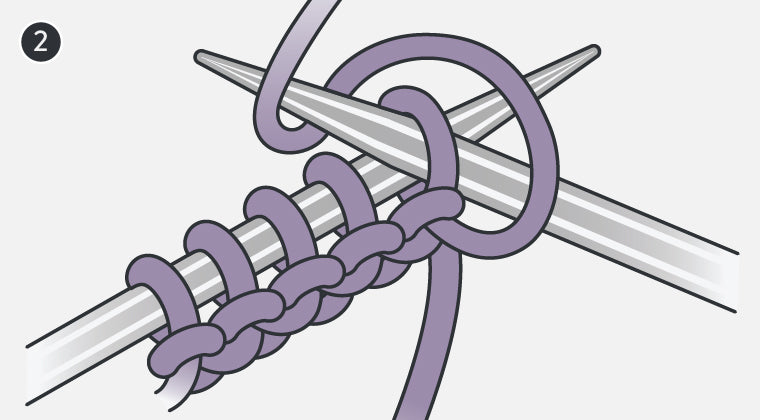
Step 3
Pull the yarn back through the stitch, forming a loop on the right needle.

Step 4
Slide the stitch off the left needle.

To purl the entire row, repeat Steps 1-4 until all of the stitches are transferred to the right needle.

Turn the work and place the needle with the stitches on it in the left hand to start the next row.
Purling every row is also considered garter stitch and makes ridges on both sides of the knitted fabric. Purling is most often used with knit stitches.
Garter
Stocking/Stockinette
-
In stocking stitch, the knit rows are the right side of the work and each stitch resembles a "V". In reverse stocking stitch, the purl rows are the right side of the work.

The edges of a piece of knitting made in stocking stitch roll under if they are not sewn together or do not have a border in a different stitch around the edges. For example, a scarf made in stocking stitch may have a border on all four edges made in garter stitch (knit every row) or in seed stitch.
Knit Ribbing
-
Ribbing forms a stretchy band and is usually found at the bottoms of sweaters, sleeves, neckbands, hat brims and mitten cuffs, and at the tops of socks. When worked as an edging, ribbing is generally worked with smaller needles than the main body of the garment to keep the edges firm and elastic.
Ribbing can be worked as K1, P1 ribbing; K2, P2 ribbing; or any combination of stitches that will be specified in the pattern.
With ribbing, you are lining up the stitches so the knit stitches always look like they are on top of knit stitches and the purl stitches always look like they are on top of purl stitches.
Knit 1, Purl 1 Ribbing (K1P1)
Step 1
Knit a stitch. Bring the yarn forward to the front of the work between the left and right needle.

Step 2
Purl the next stitch.

Step 3
Return the yarn to the back of the work between the needles.

Step 4
Knit the next stitch.

Step 5
Alternate Knit and Purl stitches until the row is finished (or for however many stitches the pattern specifies).
At the end of the row:
If you have an even number of stitches in the row, start the pattern again with a knit stitch.
If you have an odd number of stitches in the row, start the pattern again with a purl stitch.
Slip Stitch Knit
-
It is often necessary to slip (sl) a stitch from one needle to the other without actually knitting or purling it. This method is often used in shaping or within a stitch pattern.
The pattern will usually specify whether to slip the stitch knitwise (as if to knit) or purlwise (as if to purl). If it does not say, slip the stitch purlwise. The working yarn should be held behind the work in both cases unless the pattern specifies otherwise.
Slipping the stitch purlwise
Slipping the stitch purlwise is where the right needle is inserted into the next stitch on the left needle as if to purl, but with the yarn still in back of the work. Instead of purling it, transfer the stitch to the right-hand needle. This method is used when the stitch is worked on the following row.

Slipping the stitch knitwise
Slipping the stitch knitwise is done by inserting the needle as if to knit and then transferring it from the left-hand needle to the right-hand needle without knitting it. This method causes the stitch to be twisted, which can become a feature of a stitch pattern.


- Choosing a selection results in a full page refresh.
- Opens in a new window.